Shoals / Loogootee, Ind. — September 14, 2026
If you live in Martin County, you already know the sentence. U.S. 50 is closed again. Or it’s one lane. Or the hillside let go. Or the bridge over the East Fork is under a temporary signal and you will sit through Shoals longer than you planned.
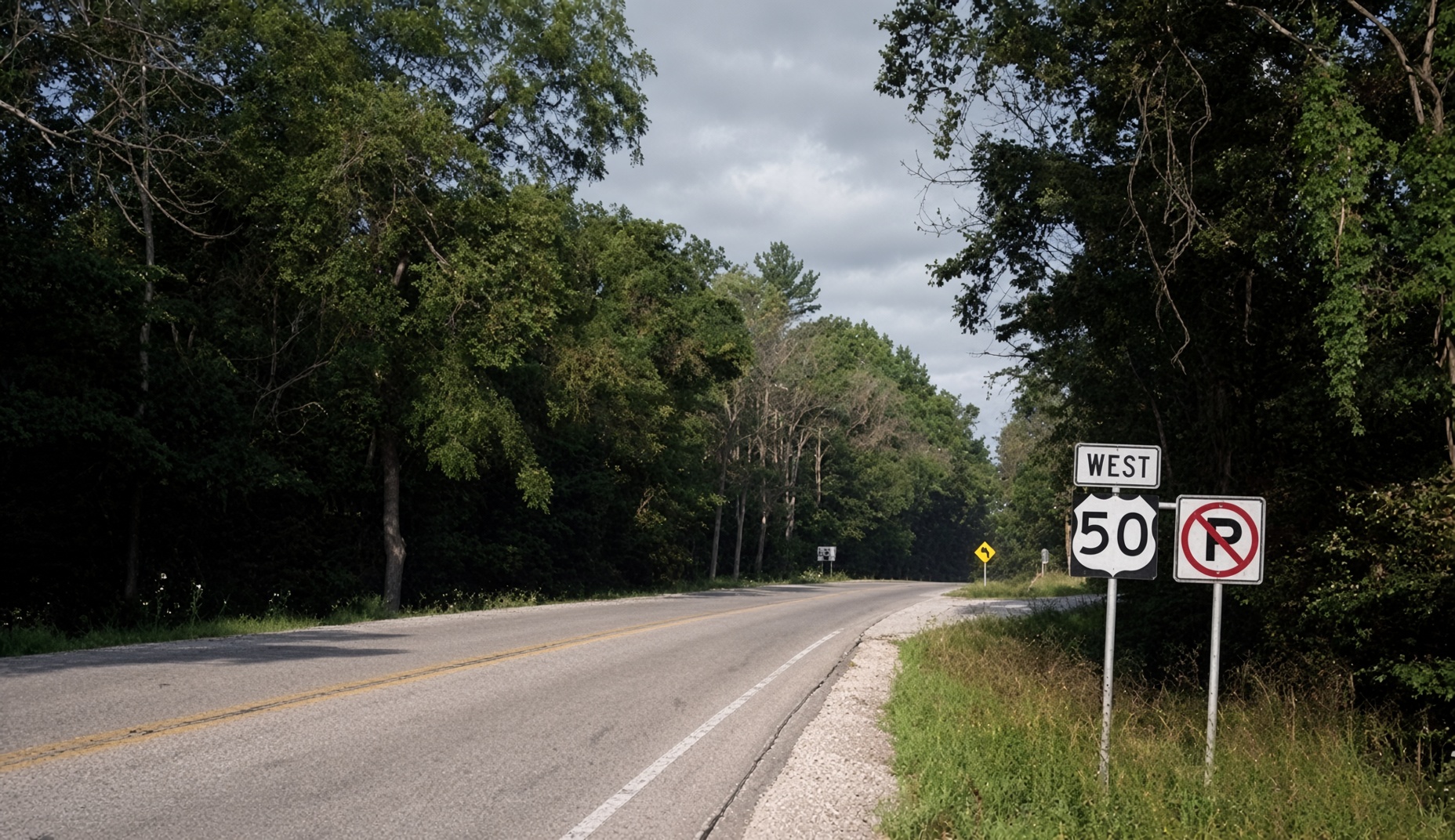
This week that is not a rumor. INDOT has daytime lane closures on the U.S. 50 bridge over the East Fork of the White River in Shoals, work slated through the end of September, weather allowing. That follows a June landslide that shut the highway east of town — about 4.75 miles east of the U.S. 50/150 split, a few tenths of a mile past the Martin State Forest entrance — until crews could reopen one lane under a temporary light. In July a jackknifed semi closed the same stretch again. The road that is supposed to connect Shoals to Bedford, the 4-H grounds to Loogootee, and farm trucks to the rest of southern Indiana keeps behaving like a patient that never quite gets discharged.
Stimulus came. This stretch was not on the list.
When Washington passed the American Recovery and Reinvestment Act in 2009, Indiana was told to expect about $650 million for roads and bridges. INDOT advertised shovel-ready jobs. ProPublica’s federal highway-stimulus tracker later listed every county’s documented ARRA highway and bridge contracts.
Martin County’s line was $0.
Lawrence County, next door on the same U.S. 50, took pavement work from State Road 37 into Bedford and work on the eastbound and westbound bridges over the East Fork White River. Knox County got a U.S. 50 resurfacing job west of State Road 241. Martin — the hilly, sliding, river-pinched piece between Shoals and the forest — did not show up in that stimulus contract list.
That does not mean no federal dollar has ever touched a Martin County road. It means the big 2009 “fix it now” highway dump skipped this county in the public project database. The later pandemic package, ARPA, was a different animal. Martin County officials said their share ran about $1.6 million and most of it went to stand up an ambulance service, not to rebuild 50. The leftover crumbs in Loogootee went to Christmas decorations, speed signs, and a couple of lots. Useful. Not a hillside.
What has reached the county in recent years is ordinary state matching money, not a second New Deal. Community Crossings sent Martin County more than $997,000 in 2021 and, in a later round flagged by Rep. Shane Lindauer, about $1.1 million to the county and $271,411 to Shoals. In February 2026 INDOT’s rural local-aid list included a $90,000 countywide safety project for Martin. Those checks patch pavement and buy a little safety work. They do not buy a reconstructed river crossing and a hillside that stays put.
Can the “Big Beautiful Bill” save U.S. 50?
Short answer: not by itself.
The One Big Beautiful Bill Act, signed July 4, 2025, is a reconciliation package — taxes, border, defense, energy, debt limit, SNAP and Medicaid. It is not a surface-transportation reauthorization and it does not write a check that says “Shoals landslide.” The pieces that touch transportation are around the edges: Coast Guard assets, FAA systems, spectrum, and a provision that zeros out the civil penalty behind federal fuel-economy standards. None of that pours asphalt on the East Fork bridge.
What actually pays for a road like this is the regular highway program. The 2021 infrastructure law that filled that pipeline is winding down. Congress has been working a successor — the House committee passed a $580 billion BUILD America 250 bill — and has already used a continuing resolution to keep programs alive into December. Indiana’s gas-tax holiday has also punched a hole in the pot that normally funds roads. Builders have warned the state is hundreds of millions short while those collections stay off.
So if Martin County wants more than another season of barrels and temporary signals, the realistic doors are the boring ones: INDOT’s regular program and emergency-relief account after the slide, Community Crossings for the local match pieces, and whatever the next five-year highway bill finally puts in Vincennes District’s hands. Waiting on a reconciliation slogan to rebuild U.S. 50 is a good way to sit in the same line next September.
Has the road killed anyone while it has been falling apart?
Yes, people have died on U.S. 50 near Shoals. No, the public record does not pin those deaths on the June landslide or the current bridge job.
On the evening of January 8, 2025, Paul M. Davis, 58, of Shoals, lost control of a Cadillac SUV eastbound on U.S. 50 just east of State Road 450, west of town. The vehicle went sideways into the westbound lane and struck a Mack semi driven by Jonathon A. Kauffman, 21, of Washington. Davis was pronounced dead at the scene. Kauffman was not hurt. State police did not blame a work zone or a slide. They described a loss of control on a two-lane highway that already carries farm traffic, Crane traffic, and through trucks.
In May 2018, six people were hurt in a three-vehicle wreck on 50 between Loogootee and Shoals, west of the fairgrounds, after a van left the road, overcorrected, and went into oncoming traffic. That was years before this summer’s slide.
What has not shown up in the clips is a fatality caused by the June 2026 landslide itself, or by the one-lane signal east of the forest, or by the current East Fork bridge work. Given the grade, the river, the semis, the temporary lights, and how fast that hillside moved, that is not nothing. It is a slight miracle in the only sense that word belongs in a road story: people have been lucky in the work zone. Luck is not a maintenance plan.
The road people actually use
U.S. 50 is not a scenic extra. It is how Shoals gets a grocery run to Loogootee, how a county truck gets to the fairgrounds, how a parent gets a kid to Bedford, how a contractor gets to Crane. When the hill lets go, the official advice is 231 or 37 or 60 — which is another way of saying go around the county.
The county can keep collecting matching grants and sitting through signals. Or it can treat this corridor as what it is: a state highway in failing ground that stimulus skipped, that ARPA did not rebuild, and that the Big Beautiful Bill will not pave. Until INDOT puts a permanent fix on the slide and the river bridge, Martin County’s main street east will keep making the same announcement. Closed. One lane. Find another way.
No thoughts yet — be the first.